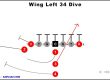
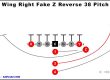
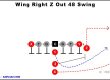
The Wing Right X Out 37 Flat is a youth football route-combination passing play from the Wing Right formation, with the wing aligned to the right, creating an additional edge threat and allowing the offense to run or pass without changing personnel.
The concept coordinates the following assignments: X runs a out route; 3-back runs the 7-side flat route. The quarterback reads the defense according to the coach’s progression and delivers the football to the first open target.
Wing Right X Out 37 Flat Play Summary
- Formation: Wing Right
- Play type: Route-combination passing play
- X: Out route
- 3-back: Flat route toward the 7-side (left)
- Protection: Offensive line and non-releasing backs use the team’s pass-protection rules
- Best use: When the route spacing attacks the leverage and coverage shown by the defense
- Main objective: stretch coverage with coordinated routes and give the quarterback a clear progression
What the Wing Right X Out 37 Flat Play Name Means
The EZPLAYZ naming system connects the formation and each eligible player’s assignment directly to the play call.
- Wing Right identifies the formation and places the wing to the right.
- X Out assigns the X receiver a out route.
- 37 Flat assigns the 3-back a flat release toward the 7-side on the left.
Breaking the name into assignments allows young players to understand the concept without memorizing a separate description for every passing play.
How the Wing Right X Out 37 Flat Works
The offense aligns in the Wing Right formation. At the snap, the quarterback takes the coached drop or quick set while the offensive line and non-releasing backs establish pass protection.
The X receiver should gain the coached depth and break decisively toward the sideline. The route attacks the outside sideline window and must remain properly spaced from the other assignments.
The 3-back releases toward the 7-side on the left and should release quickly toward the sideline and gain width underneath the coverage. The back must avoid leaving before completing any assigned protection check.
The quarterback identifies defensive leverage, follows the coached progression and delivers the football before the throwing window closes. If the primary route is covered, the quarterback works to the next defined option rather than forcing the pass.
Why the Passing Concept Can Be Effective
Route concepts work by attacking different levels or areas of the coverage. A short route can hold an underneath defender while another route threatens the space outside, inside or behind that player.
When every receiver maintains the correct depth and spacing, the quarterback receives a clear progression instead of several players occupying the same throwing lane.
Player Assignments
Quarterback
- Receive the snap and use the drop or quick-set footwork established for the play.
- Identify defensive leverage before the snap and confirm it after the snap.
- Move through the coached progression and deliver a catchable pass on time.
- Protect the football if pressure or coverage removes the throwing window.
X Receiver
- Gain the coached depth and break decisively toward the sideline.
- Maintain spacing from the other routes and avoid drifting into another player’s area.
- Show the hands to the quarterback and secure the football before turning upfield.
- Finish the play with a legal block if another receiver catches the pass.
3-Back
- Check the assigned protection responsibility before releasing.
- Release quickly toward the sideline and gain width underneath the coverage toward the 7-side.
- Keep proper width and spacing from the receiver routes.
- Secure the catch before accelerating upfield.
Backfield Protection
- Identify the most dangerous inside or edge pressure before the snap.
- Step into the block with balance and protect the quarterback’s throwing lane.
- Release only when the play assigns a backfield route.
- Do not turn to watch the pass before completing the protection assignment.
Offensive Line
- Use the team’s established pass-protection or screen-protection rules.
- Protect inside gaps first and communicate twists or overloads.
- Maintain a firm pocket or release at the coached screen landmark.
- Avoid moving illegally downfield before the forward pass is released.
Best Situations for Calling the Play
- When the route spacing attacks the leverage and coverage shown by the defense.
- On manageable passing downs where the quarterback can throw on rhythm.
- After the running game has encouraged linebackers and safeties to play forward.
- When the offense wants to pass without changing its Wing Formation personnel.
- When the protection can account for the defense’s most dangerous pressure.
Coaching Points
Use Consistent Route Depth
Route depth creates spacing. Receivers who cut too early or too late can bring multiple defenders into the same throwing lane.
Make Sharp Breaks
Receivers should sink the hips, plant under control and accelerate out of each break.
Throw on Time
The quarterback should anticipate the open window instead of waiting until the receiver is surrounded by defenders.
Protect Before Releasing
Backs and receivers assigned to protection must finish the block or protection check before looking for the football.
Catch Before Running
Receivers should secure the pass with the eyes and hands before turning upfield.
Common Execution Mistakes
- Mistake: Routes are rounded instead of making decisive breaks.
- Mistake: Receivers drift into the same area and remove the intended spacing.
- Mistake: The quarterback stares at one target from the snap.
- Mistake: Protection players release before the quarterback is secure.
- Mistake: The ball is thrown late after the defender has recovered.
How to Install the Play at Practice
1. Align the Formation
Confirm the wing alignment, receiver splits, backfield depth and eligible-player positions.
2. Teach Each Route Separately
Use cones to establish release angles, route depth and catch landmarks.
3. Drill Quarterback Footwork
Run the concept on air so the quarterback learns the drop, read and release timing.
4. Combine the Route Spacing
Run every route together and correct players who enter another route’s area.
5. Add Protection
Walk through line and backfield responsibilities against the expected defensive fronts.
6. Add Defensive Reactions
Use scout defenders to show different coverages and require the quarterback to follow the progression.
Building a Wing Formation Series Around This Play
This passing concept is most effective when it is paired with runs and passes that begin from the same alignment. Consistent formations and first steps prevent the defense from identifying the call before the routes develop.
Useful companion concepts include:
Why This Play Is Useful for Youth Football
The Wing Right X Out 37 Flat gives a youth offense a passing concept from familiar Wing Formation personnel. Players can focus on route depth, protection, spacing and quarterback timing without changing the entire offense.
The consistent EZPLAYZ naming structure also allows coaches to teach each eligible player’s assignment directly from the play name.
Wing Right X Out 37 Flat FAQs
Is the Wing Right X Out 37 Flat a passing play?
Yes. It is a youth football route-combination passing play from the Wing Right formation.
Who is the first receiver or back in the play name?
The first listed assignment is the X running a out route, although the coach can define the exact quarterback progression.
How should the offensive line protect?
The line uses the team’s established protection rules, protects inside gaps first and follows the coached screen timing when applicable.
Why is route spacing important?
Correct spacing prevents multiple defenders from covering several eligible players in the same area.
What should the quarterback do if the primary route is covered?
The quarterback should move to the next defined read or protect the football rather than forcing the pass.
Can the route depths be adjusted for younger players?
Yes. Coaches can shorten route depths while preserving the same spacing, timing and naming concept.
Explore More Youth Football Plays
Browse additional Wing Formation plays, animated football diagrams and downloadable EZPLAYZ playbooks for your youth football offense.
How to use EZPLAYZ
Organization and execution….those 2 words are crucial to the success of any youth football program and I’m not aware of a coach who wouldn’t utilize all the tools at his disposal to ensure that his team enjoys the most successful season possible. This is where EZPLAYZ can help! Coach Ragland and I have teamed up to bring you the simplest, most comprehensive animated football playbook ever created. With its easy-to-use format, your players will be able to VISUALIZE the plays at home which, in turn, will afford you more time to INSTRUCT them on how to properly EXECUTE the plays. From there, all you have to do is WIN!
EZPLAYZ Receiver Designations
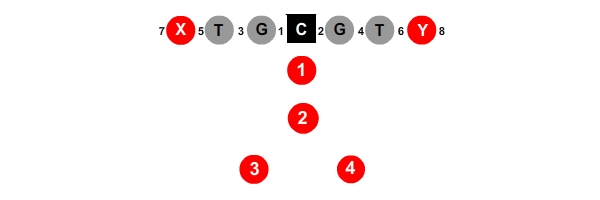
In a Balanced Formation (eg. Wishbone):
- X receiver is always on the left side of a balanced formation (typically a Tight End).
- Y receiver is always on the right side of a balanced formation (typically a Tight End).
Wishbone Formation
In a Strong Side/ Weak Side Formation* (eg. I Left)
- X receiver is the eligible receiver on the weak side of the formation.
- Y receiver is the inner eligible receiver on the strong side of the formation.
- Z receiver is the outside eligible receiver on the strong side of the formation.
I Left Formation
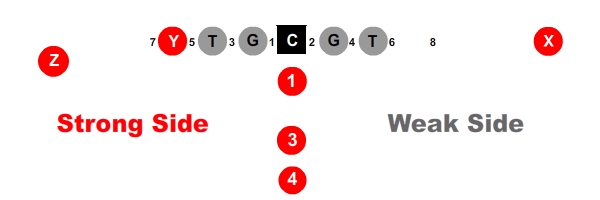
- For the understanding of your players, the strong side of the formation is the side on which there are more players. Conversely, the weak side is the side with fewer players. Make sure your players don’t get this confused with the wide side and short sides of the field.
EZPLAYZ Passing Routes (Passing Tree) and Play Naming
Receivers Passing Tree
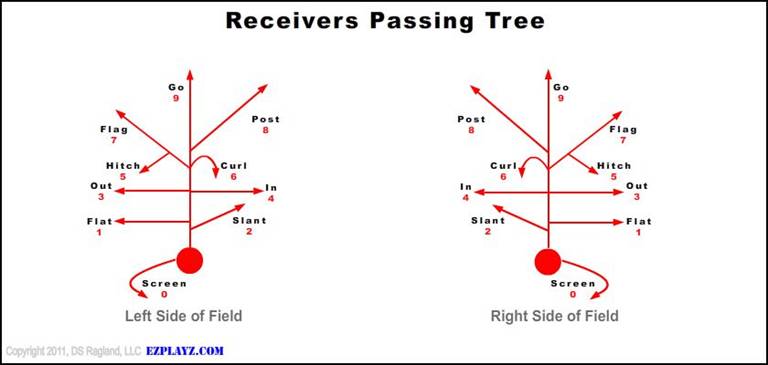
Play Naming with Passing Routes
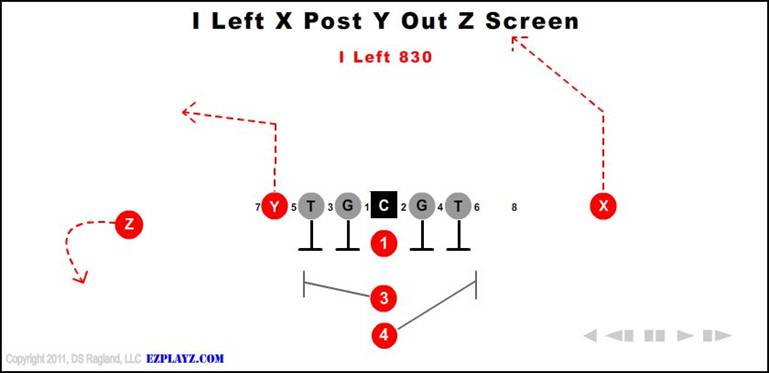
- EZPLAYZ utilizes two (2) play names for some passing plays. In this example, there is a long version (I LEFT X POST Y OUT Z SCREEN) to make sure that when the play is called, it is completely clear to the players; specifically those who are going out on the routes.
- The shorter version (I LEFT 830) is for the more experienced players. The numbering system always goes from Weak to Strong Side. In the example above, X-8; Y-3; Z-0
EZPLAYZ Blocking Schemes
EZPLAYZ offers three different blocking schemes:
- Zone Blocking
- Blocking Rules
- Pass Blocking
We have intentionally chosen not to put in detailed blocking assignments for a number of reasons:
- Quite simply there are just too many combinations of blocks and defenses the line may be encountering to cover them all. For example, if you were to cover all the blocking possibilities for a 7 man front against a 4 man D-Line, there are 840 possibilities of how that 7 man front can block!
- You have your own blocking rules that you want to implement in your strategy.
- Specific blocking schemes that I design as a coach are based on my talent and strategy which will both differ from yours. The last thing you need is a play that demonstrates something very specific which will not be applicable to your team.
Blocking Rules
Blocking rules are your rules that you want your kids to follow. Whether GOOLS (Gap-On-Outside-Linebacker-Safety) or some other standard blocking scheme or even your own, our Blocking Rules play format allows you a great deal of flexibility.
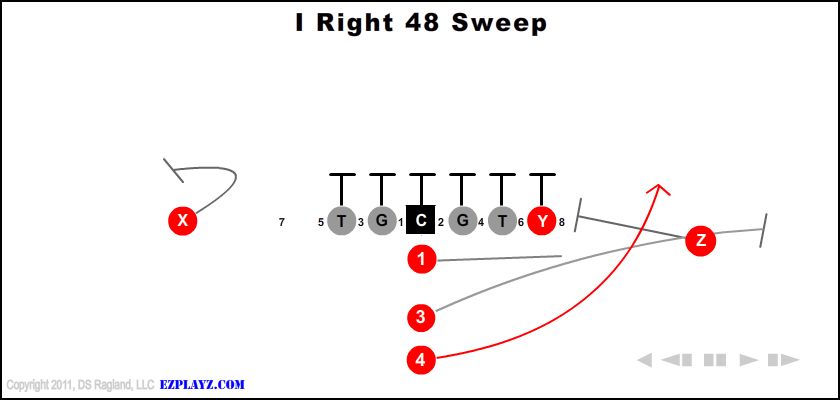
Blocking rules are your rules that you want your kids to follow. Whether GOOLS (Gap-On-Outside-Linebacker-Safety) or some other standard blocking scheme or even your own, our Blocking Rules play format allows you a great deal of flexibility.
Zone Blocking
Zone Blocking is blocking towards the play side of where the play is going. I’ve had a lot of coaches argue with me over Zone Blocking. They say, “Why in the world would you want to block where the play is going?”, well I’ll tell you why, simple physics.
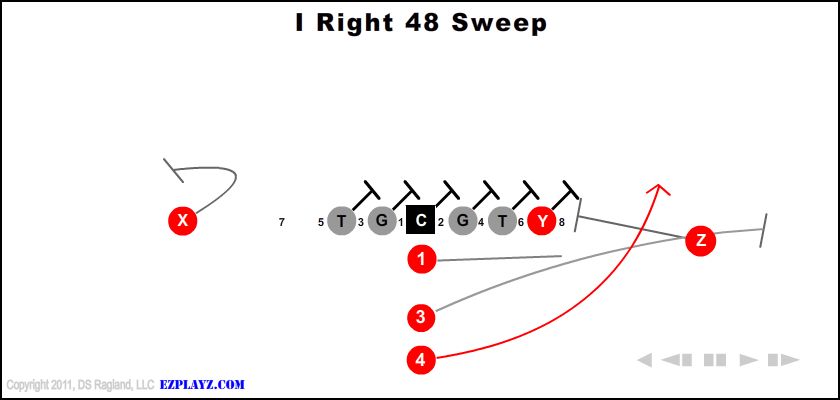
“Push the player in the direction they are already going!”
This is exactly what makes this an effective blocking scheme. It is much easier to push someone in the direction they are already moving, versus pushing them in the opposite direction. This also allows the opening up of running lanes for a quick footed running back to exploit as well as upfield blocking by your linemen in the second and third levels.
Blocking away from the play is effective only as long as you can hold your block, once you lose your block you are out of the play and the player you were blocking is free and clear to wreak havoc on your runner.
Zone blocking also allows you to better utilize a smaller line and still be effective. Let’s face it in youth football you can have mismatches of 140 pounds versus 80 pounds. If the 80 pounder is trying to push the 140 pounder in the opposite direction, he will lose that battle 99% of the time.